
Earlier this year I came out of software development retirement to find out what AI-assisted development is actually like from the coal face. I was aiming for a fair test rather than a demo, so I made the brief deliberately awkward.
I wanted a spread of component types: database, API, front end, and something genuinely agentic. I wanted messy real-world data of varying provenance rather than a clean dataset. I wanted a user interface where useability and taste mattered, which I find hard. And I used frameworks that were entirely unfamiliar to me, and languages where I have very shallow experience (Python and TypeScript, mainly). Admittedly, that last point was because I'm so long in the tooth: turns out that J2EE on Tomcat has fallen out of fashion...
Then there was one hard rule: I would never read or hand-edit the code.
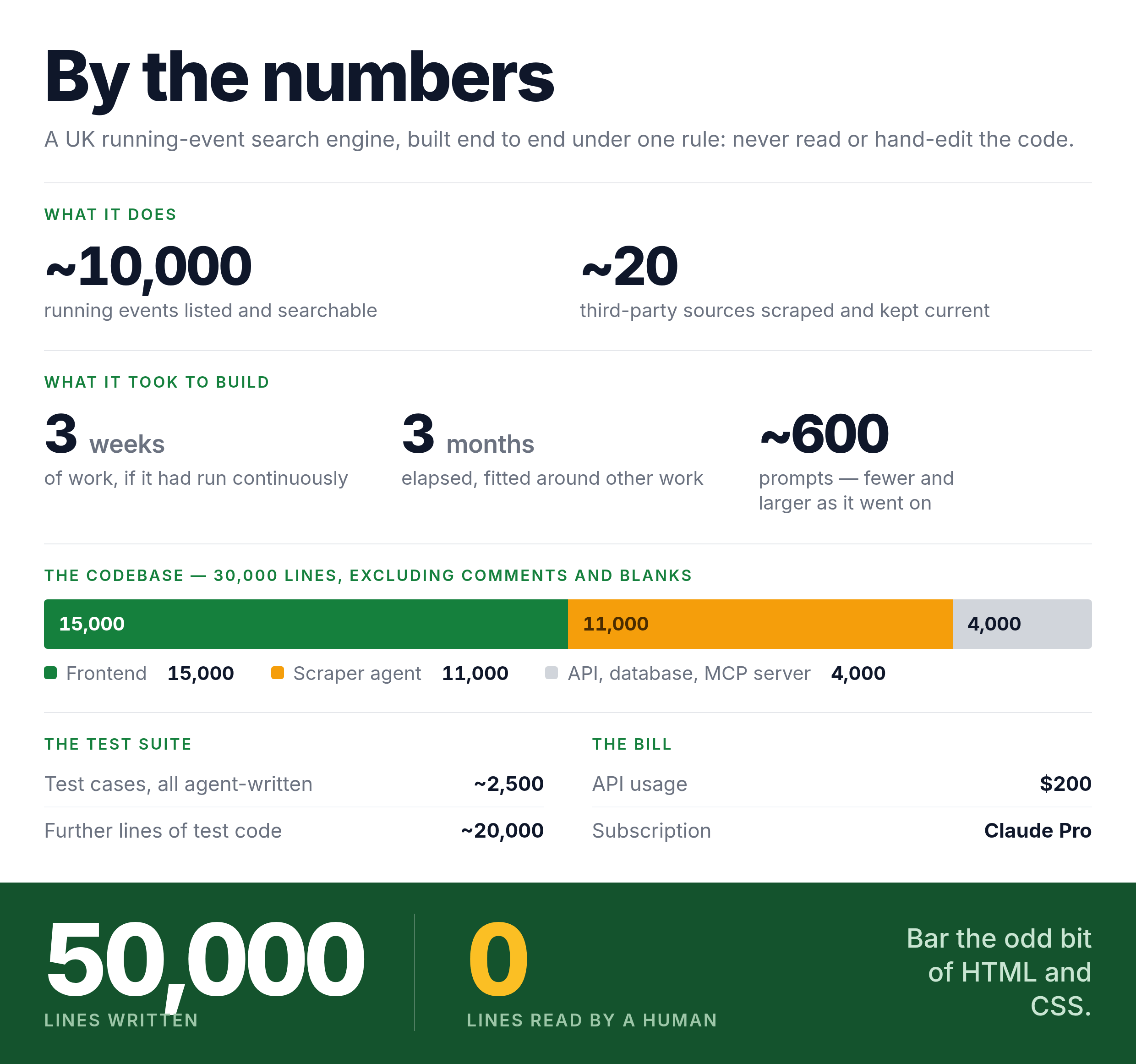
What came out is Race Directory, a UK running event search engine with about ten thousand races in it, deployed and in use. Three of its four major components came out well. The fourth is, ahem, a house of cards. The interesting part is why was that component poor, because I think the reason turns into a practical rule about where to spend your attention with AI-assisted coding.
Race Directory is live at race-directory.co.uk.
How I worked
This wasn't a free-for-all. I settled on Claude Code early, having tried Antigravity and Gemini CLI, mostly because Gemini's quota cap was unpredictable at the time. After the first couple of weeks, I used planning mode throughout and always reviewed and edited the plans before implementing. I asked the agent to build tests as it went along, and as I refined my agent instructions file the workflow became rigorously test-driven. The code lived in GitHub with CI/CD across local, staging and production environments.
I didn't open and edit the code in an IDE. This was a deliberate part of the experiment and nothing to do with me being lazy, honest. I did edit the odd bit of CSS or HTML where the change was trivial and faster than prompting, but I never manually changed "proper" code. Much later, I cast my eye over some Python and TypeScript files, which was more of a quick "how smelly is this?" check than anything approximating a code review.
Initially I shied away from Claude's automation mode and reviewed requests for permission carefully. Over time I got more comfortable with automation - not because I got sloppier, but because the scaffolding around the agent got stronger: a substantial test suite, a CI pipeline that would catch things, separate environments, and a maturing set of rules in CLAUDE.md. Maybe I was lucky, but across six hundred-odd prompts my experience of the agent doing something genuinely dangerous was extremely rare, and the very few times I did have a "whoa, why are you running that against the production database?" moment, it was usually mea-culpa as I'd previously given permission for a very similar command.
What went well
The front end, database schema and API code were all reasonable. I'm not saying I'd put them into production for a mission-critical application, but the shape and feel of the code was structurally decent and it wouldn't take much to kick it into adequate shape: a tidy-up, not a rewrite. They had sensible boundaries, roughly where you'd draw them yourself, and something you could hand to another engineer without a covering apology.
The AI generated tests surprised me more, because I was initially sceptical due to what others had told me about AI driven testing. The whole app has around 2,500 test cases, all written by AI. In my plan reviews I sometimes requested the details of the test coverage to be expanded and I'd ask "how are you going to test X?" type questions, but I never specified actual test cases. I was expecting to find a good sprinkling of tests that tested nothing, or tests rigged to pass. But that wasn't my experience. The selection of test purpose, with negative and positive tests, was pretty good I didn't come across the agent cheating to keep the suite green. Quite the opposite, in fact. Take this example:
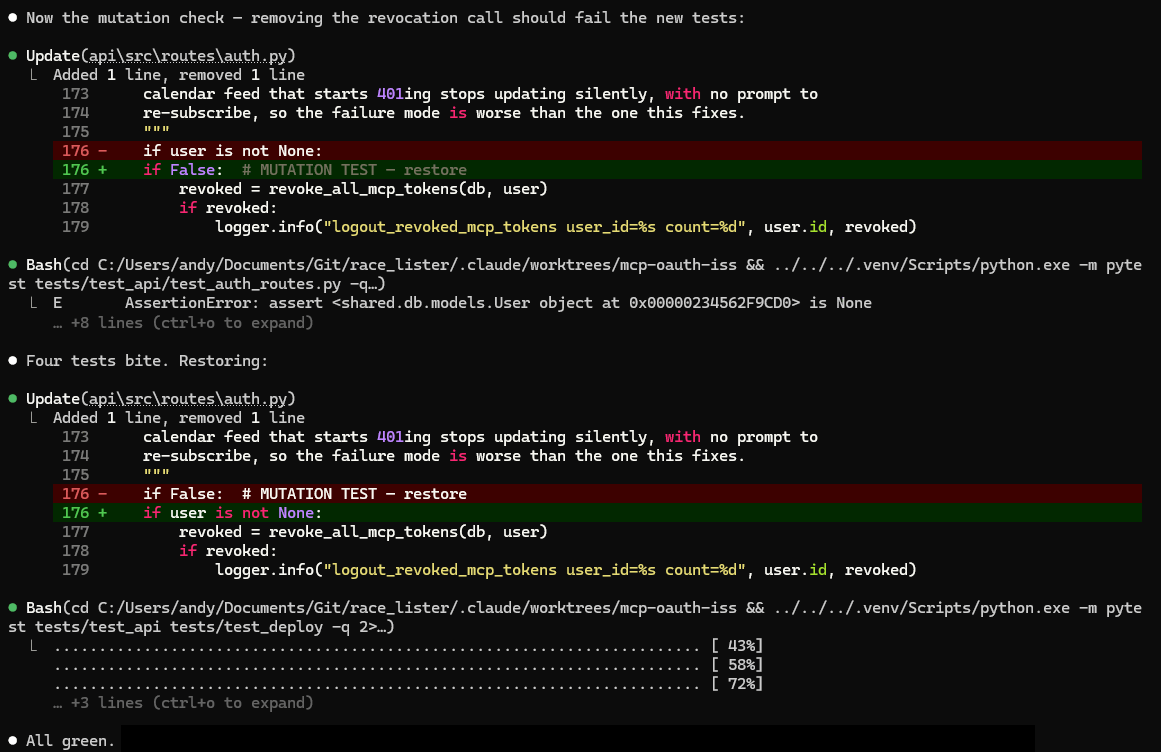
The tests were green. The agent then proposed its own mutation check - removing the revocation call should fail the new tests - went into the source file being tested and replaced "if user is not None:" with "if False:", tagged with a comment reminding itself to put it back. It re-ran the suite. Four tests failed, on real assertions rather than a crash. Conclusion: "Four tests bite. Restoring", so it reverted the change and went green again.
All of this happened without a prompt from me.
Then the scraper agent
The fourth component was different in kind. It was a bespoke agent designed to autonomously create and maintain about twenty web scrapers with no human intervention. Turns out there are a bewildering number of scraper corner cases and failure modes, and they multiply in a way that a well-specified API simply doesn't. It ended up as eleven thousand of the thirty thousand lines of production code - over a third of the application, and comfortably the largest thing in it after the front end.
Fairly early on I asked whether a proper agent framework, such as LangChain, and data pipeline architecture would serve better. The answer was roughly along the lines of, "nah, hand-rolled Python and a few libraries is just fine here". My listening to that answer was definitely a mistake!
The lesson for me was there was no moment where this looked clearly wrong.
I have plenty of stories about the agent being obviously dumb, and I'll come to one. But this wasn't one of them. No blatantly bad suggestion appeared for me to push back on. The problems then accumulated: each patch and new feature was reasonable, each one another card on the pile. By the time it was visibly a house of cards, the decision that caused it was thousands of lines behind me and reversing it was expensive.
I wouldn't put that scraper code anywhere near production in a system where security or reliability mattered. We're well into throw-it-away-and-start-again territory, though the deeper understanding of the requirements and the system test cases can be claimed as wins.
Where to spend your attention: design, not code
So why did the same agent, the same tooling and the same person produce three good components and one bad one?
Not because it was better at CRUD than at agents, I think. It's that the errors land differently. An agent wrong about code implementation costs you a retry and the blast radius is small. An agent wrong about architecture compounds quietly and surfaces thousands of lines later, when reversal is expensive. My sense is that it's wrong about as often in both cases - the difference isn't frequency, it's affordability.
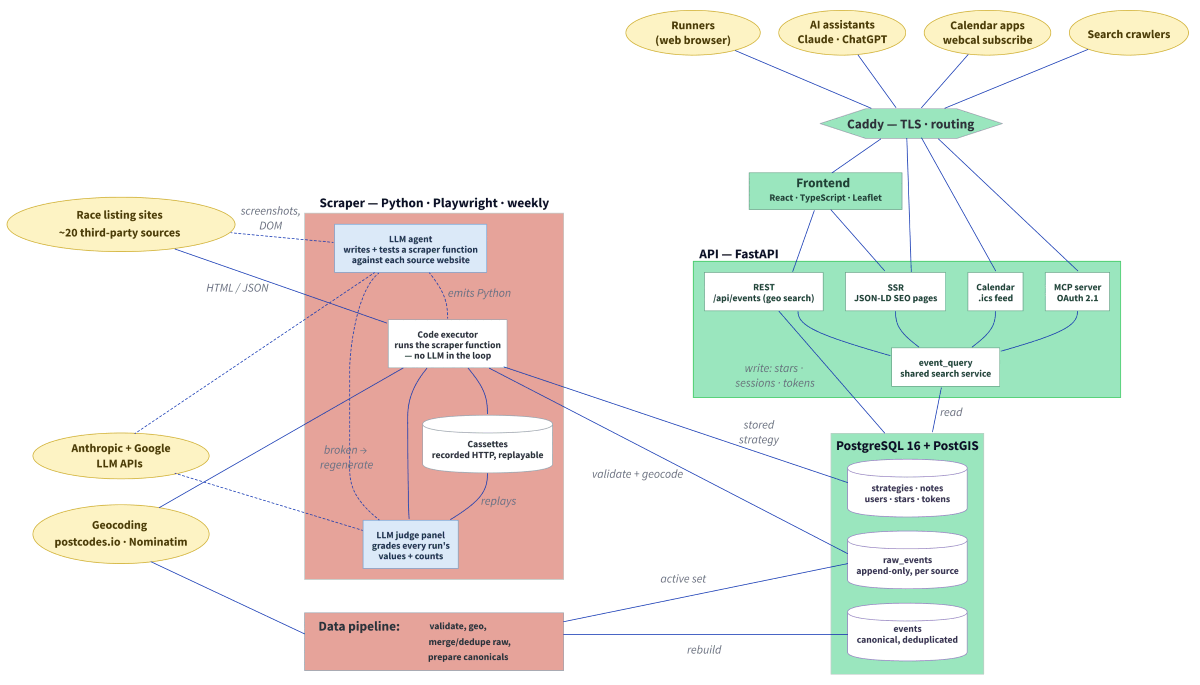
The green components was where the code was satisfactory and sustainable. The red component, the scraper agent was the area where the architecture was poor and the code gradually unmaintainable.
(The MCP server in that diagram is live, incidentally, at race-directory.co.uk/mcp, if you'd like to point your own AI assistant at it.)
There's a related failure pattern that took me a while to nail down. Far too often the agent would speculate on a root cause without good evidence: based on a couple of weak examples, it would draw an overly-firm conclusion, and propose a design off the back of it. A simple questioning prompt from me, something like "what's your evidence for that?" or "have you looked in the database for other examples?", would regularly cause it to U-turn on its recommendation. A search of my prompt history for this project turned up over twenty of these "show me the evidence" examples. And remember what that number is: the twenty+ times I caught it. The ones that went through unchallenged aren't in my search results, by definition - and they're also what the scraper is made of.
Eventually I stopped catching it one at a time and put a rule in my CLAUDE.md instead:
Do concrete analysis (read code, query live DB, run a wide set of reproductions) before proposing designs or analysing root causes; never speculate without evidence.
That seemed to help somewhat, but certainly isn't a panacea.
I distil all this into a practical rule that has two halves: steer and review at the design level.
- Steer at the design level: the plans you write, the constraints you set before anything is built, the rules in the agent instructions file. That's actually the cheap half, but it is still easy to skip.
- Review at the design level: spending the bulk of your human review budget on architecture and design decisions, and consciously prioritising what code review you do towards complexity and risk, not every PR.
That's a different review allocation from the one many teams use. Often the apparatus of software review - pull requests, diffs, line comments - focus at the code layer, which is usually where being wrong is cheapest in AI-assisted software development.
So, did never reading the code cost me anything? Less than I expected, because the decisions that mattered most were upstream of it, in the plans and designs I did read. That's not an argument for nobody reading code. It's an argument for reading it selectively, and moving the attention you free up to where the errors compound the most.
Not a junior engineer
Plenty of commentators liken working with a coding agent to working with a junior engineer. I understand the comparison, but I think it misses three differences that undervalue coding agents.
Firstly, agents are much faster: getting an output, good or bad, within minutes or a couple of hours while your head is still in the problem is materially different from getting feedback the following day or week. Secondly, agents bring a breadth and depth of coverage that is undeniably useful, often catching corner cases and design flaws I wouldn't have spotted - and on many occasions pointing out considerations I suspect a solid senior engineer wouldn't have spotted either. Thirdly: it's far easier to push back. I can reject an approach outright and ask for the whole thing again, and it costs very little. With a person, I'd hesitate to ask anyone to bin three days because human relationships are at play and because work is expensive - wasting three days just feels unacceptable. So I attempt things with an agent that I'd talk myself out of asking a human colleague to redo.
There's a flipside of course. When a junior redoes work, they learn something and the next piece is better. With the agent, the accrual of learning is hit-and-miss at best. Even the short-term (in session) memory of an agent can be frustratingly unreliable. Once, mid-session - after a compact, I suspect - the agent proposed switching my endless scrolling list design back to paginated, a decision we'd already made deliberately after a reasonably in-depth analysis. I reminded it of the earlier analysis and it folded instantly: oh yes, good point, ignore my suggestion. The context was there; the agent just didn't weigh it on that occasion.
This ability for agents to be both very smart and very dumb in unpredictable ways takes some getting used to, but I definitely don't think it's a dead-end.
It's important to say that my critique of the junior engineer analogy entirely misses the bigger question: where does the next generation of software engineers come from? I strongly believe a range of engineering skills are still vital - albeit skills that differ from 5 years ago - and that means we must still support their development, even if the calculus around their value in short term, initial deployment has changed.
And then to Montenegro
Early on, my wife looked over my shoulder and asked what on earth I was doing. So I showed her the app, to which she responded: "are there any races in Montenegro when we're there on holiday?"
A couple of months later, six of my family toed the line at the Bjelasica trail race.

Which of course is the ultimate test for any software: will people actually use it? If you're a runner or just fancy a look, it's at race-directory.co.uk.
I made a set of public predictions about AI-assisted development back in Q1, and later marked my own homework in light of this hands-on experience.
I first published this on LinkedIn, where you can join the discussion.