
In my previous blog, I argued the role of humans in editing software code will diminish as agentic vibe-coding dominates. But vibe-coding won't permeate all software domains at the same speed: there will be areas where human review of code is still required and use of AI is limited, even ten years from now. I call these areas holdouts.
As vibe-coding practices mature and become more accepted, I think the doubters will shift from saying “AI can’t write large, maintainable systems” to “yeah, vibe-coding’s great, but we can’t use it because we build <insert holdout domain here> software”. Maybe that will be valid, but sometimes it won’t be. This matters because understanding whether you really have a valid reason is fundamental to your software approach.
I categorise these holdouts into the following areas.
- Niche and proprietary ecosystems
- Software using unusual hardware, particularly for input/output
- Safety and mission-critical software
- Large legacy systems
- Highly complex algorithms and workflows
- Performance and memory constrained software
- High security and cryptographic systems
- Artisan software
These are overlapping and fuzzy sets: a single software system might fit into more than one of them. For example, a medical device might be memory constrained, safety critical and use unusual hardware. Here, the unsuitability to vibe-coding compounds as the cost-benefit-risk trade-offs become increasingly unfavourable.
Right, let’s consider the holdouts in turn.
1 Niche/proprietary ecosystems
Areas where documentation and example code are not in the public domain are often cited as unsuitable to vibe-coding since LLMs haven’t been adequately trained on relevant data. This may be true in the short term, but I think this will be one of the first holdouts to fall for the following reasons.
- Although coding quality benchmarks show lower LLM performance for niche languages, they’re still better than equivalent performance of LLMs in Python or JavaScript, say, just 1-2 years ago. The LLM coding performance of Python and JavaScript – both past their 30th birthday – hasn’t improved recently just because of better training data.
- New RAG techniques will also improve the ability of LLMs to write good code based on codebases and proprietary documentation provided post-training.
- As mentioned in the first blog in this series, LLMs do not need to have been trained on a language to be able to write code in it.
- The cost advantages of vibe-coding are likely to drive increased usage of LLM-friendly languages. This doesn’t necessarily mean language consolidation, since new LLM-friendly languages will appear – it seems LLMs can effectively generate code in some unfamiliar languages and not others. This distinction isn’t well understood but it suggests that using a domain specific language with your LLM, even one invented for your new project, isn’t out of the question.
Vibe-coders from more AI-friendly domains will turn their attention to these niche and proprietary ecosystems if there’s commercial value in them. I predict they will be largely successful, so you’re playing a risky game if you’re relying on “niche” as your moat.
2 Software using unusual hardware, particularly for input/output
Sometimes reading software blogs, you could be forgiven that all software is written to run on a server, a PC, or a mobile phone. An awful lot of software runs on other devices, such as TVs, medical devices, train control systems and factory robots.
Production grade vibe-coded software cannot rely on human testing to validate its functionality. Keeping coding agents on track with fast, agent executed quality feedback loops is fundamental. Web apps, back-end services with APIs, and mobile apps all have software-only ways of running and testing the software at the whole-system level, even if it sometimes involves simulators, e.g. for mobile apps. For web apps there are already very mature ways of doing this with tools such as Playwright MCP, Chrome Dev Tools MCP and many others.
But software running on those other devices usually lacks this convenience. More often than not they will have quirky, non-standard input and output: the train driver uses all sorts of switches, buttons and controls; while the nurse’s medical device has blinking LEDs and an LCD display. In these cases, it’s often still possible to introduce bespoke test harnesses, simulators, mocks and digital twins that enable coding agents to validate and get test feedback without human intervention. However, the additional cost of this engineering, combined with the reduced value of a smaller market often means this isn’t worthwhile.
Nevertheless the cost-benefit calculus will become more favourable because building that bespoke test harness will itself be much cheaper. It’s also worth noting that lower level tests, such as unit and integration tests, are for the main part hardware independent so this kind of essential agent back-pressure is equally achievable in this holdout.
Aside from the testing challenge, there are other idiosyncrasies to developing embedded software. The challenges here are largely similar to those of other proprietary ecosystems and are likely to diminish fast also.
3 Safety and mission-critical software
Safety critical software – whether in transport control systems, nuclear power stations or medical devices – will be an area where the adoption of vibe-coding will be much slower and in some cases impossible. This is equally true for mission critical software – such as banking payment transaction systems, satellite control systems or CPU firmware – where compliance can require systems to be traceable or explainable, or where failure is extremely costly even if it doesn’t present a direct risk to safety.
In many cases, applicable regulations stipulate certain software engineering approaches must be followed. For example, some aerospace regulations recommend the adoption of formal methods to assure the software works in a rigorously provable way. It’s interesting that the formal methods community is starting to consider the challenges and opportunities of combining LLMs and formal verification.
That said, the regulations in these domains rarely enforce formal methods; for the most part the regulations require providers to use traditional software techniques more diligently. There are plenty of cases where this has spectacularly failed to work – think of medical devices that have been compromised by cyber attacks or the Prius car braking software control system controversy.
Is it possible that a greater focus on specification and testing – with less understanding and focus on the underlying implementation and code – could improve software quality in these areas? Might regulators shift from demanding “evidence that you specified, built and validated this software thoroughly” to “evidence that you specified and validated this software diligently”? I strongly doubt that’s going to happen. A lot more experience of and quantitative evidence for the quality of LLM created software will be needed before a significant shift is likely. Regardless of the future quality merits or otherwise of vibe-coded software, regulation and regulators move slowly and it’s unlikely that vibe-coded software will be prevalent in heavily regulated domains any time soon.
Compliance and accountability for software is an overlapping but different challenge. Some regulations require the provenance of code to be auditable and the code to be explainable. Vibe-coded software is still a long way from being able to provide this.
4 Large legacy systems
It will always be easier to adopt agentic vibe-coding for greenfield development. Trendy start-ups often have that luxury, but older companies with large, existing code bases do not.
What’s that you said? Your Sybase database has 3 million customers in it, the schema is on version 8, there appears to be a bug in a stored procedure that Bob, now retired, wrote 14 years ago, and, yeah, the test coverage wasn’t all that great in the first place. You’re probably not going to be vibe-coding that fix. LLM’s may play a role in tracking down the bug and suggesting a fix, but ultimately you need a human in the loop. If you think that scenario is far-fetched, you need to hang out in some big banks or government departments for a while.
For different and equally valid reasons, I suspect that a vibe-coded Linux kernel patch submission would meet a frosty reception.
The common thread to these examples is a large and interconnected body of code, where the understanding of how the code works, knowing the side effects of changes and the ability to thoroughly test those changes are all limited. It turns out that LLMs are pretty good at aiding understanding of large, brownfield code bases: C3’s and Tabnine’s are two example tools that do this, from a large selection. However, safely updating the code base is a different problem and getting LLMs to do this won’t always be possible or sensible, particularly when the automated testing is inadequate. In my view, large distributed systems will be particularly unsuitable for agentic maintenance – perhaps an individual node (e.g. micro-service) could be updated, but only if its contract is unchanged and it has a thorough automated test suite.
More often than not, today’s legacy systems will be retired before vibe-coding can play a significant maintenance role. As they’re replaced by new, vibe-coded systems I predict the number of legacy systems that cannot be vibe-coded purely because they’re old and large will very slowly trend towards zero.
5 Performance and memory constrained software
Generated code – whether from an LLM, a compiler, or a no-code platform – creates another layer of abstraction between the silicon and the engineer. This nearly always leads to a level of bloat, sometimes in memory footprint, sometimes CPU cycles, sometimes both. Vibe-coded software is no different. Often that bloat doesn’t matter – Moore’s law has rescued us – and the software can increasingly be a “black box” with developer efficiency placed at a premium and the bloat downsides hidden by better hardware.
But performance can still matter and there are broadly two cases where this influences software approach.
- Consumer electronic and embedded devices where the hardware is necessarily low cost. This could be your washing machine firmware, a low-end set-top-box, your hotel key card or a smart light bulb. In these examples there sometimes just isn’t the memory or CPU cycles to allow for unoptimised, bloated software.
- Applications running on capable hardware, where performance is at an absolute premium. Many console games, for example, go to great lengths to squeeze out high performance whether in frame rate rendering or physics engines. Another example is the demands of high-frequency trading, where the lengths gone to in search for better performance is even more extraordinary. In these examples, not only does the performance have to be “acceptable”, it has to be better than the competition, which means if there is a way to go faster it will be explored.
So, just as assembler still gets used today, there will be times when human inspecting and optimising at the code level will continue to happen. Code optimisation, often treated as an after thought or nice-to-have today, should eventually be well suited to the attention of coding agents as performance is readily measurable. So I’m optimistic that optimisation will become cheaper and “just another thing the agents take care of” in a future world, but not in the short term and not in all cases.
6 Complex algorithms and workflows
For advanced workflows such as unusual data models, rare algorithms, or highly industry specific workflows, the software complexity can be an order of magnitude greater than typical systems, and the business logic needed is sometimes unique. That means there will be few, if any, code examples for the LLM to be trained on. What’s more, these cases often won’t lend themselves to a natural language description intended for an LLM; sometimes the representation of the algorithm is better captured in code or some other formal language. Combine these factors with the inevitable hidden corner cases that must be designed for and tested, these complex scenarios do not lend themselves to vibe-coding.
That said, this holdout will gradually shrink for two reasons. Firstly, as agentic coding gets more capable, it will be able to write solid code for the “easier” scenarios. Secondly, there is a tendency today for software engineers to believe that their problem or workflow is unique to them, when, in fact, once the industry jargon is stripped away and the problem is presented in its simplest terms, it has often been solved elsewhere. Sometimes, it may even fit into a nicely named design and architecture pattern. Today the advantage of finding and adopting existing design solutions over “rolling-your-own” is somewhat marginal and too often ignored. But in the future, engineers are more likely to make the effort to reduce a workflow or data model to its simplest form, because they know doing so will be rewarded by being able to implement it far more cheaply with their friendly coding agent.
7 High-security and cryptographic systems
This holdout describes software that implements cryptographic and security libraries and tools, as opposed to general purpose software that needs to be secure – which would cover most software written today! It nearly didn’t get its own section, since arguably this holdout is just a special case combination of the mission-critical and complex algorithm holdouts (see 3 and 6 above). But then I realised the picture would look prettier if there were eight holdouts, so cryptography gets its own special consideration.
High-security software focused on encryption and privacy requires a level of mathematical rigour and "zero-defect" logic that current LLMs cannot guarantee. If the software is a library, say, that forms an integral part of the security of hundreds of third party applications, then a defect can lead to a large and catastrophic blast radius when thousands of disparate systems are suddenly found to have backdoors.
Security audits require deep, expert, line-by-line understanding of logic to ensure there are no backdoors or side-channel vulnerabilities. It has been found that the “thousands of eyes” public auditing of open source solutions usually leads to more robust security than “security by obscurity” of proprietary solutions. So human review of cryptographic code isn’t going away, as no amount of black-box testing can replace it.
8 Artisan software
Might there be a market that prizes hand-written software? After all, there is for hand-crafted chocolates or leather bags; items that people are happy to pay more for, even when the goods are empirically little different to cheaper, factory made equivalents. Given that software is for the most part intangible and each version distributed has no “mark of the maker”, it seems unlikely to me that buyers will place a premium on it being human written.
Software makers, on the other hand, will no doubt continue to hand-code for pleasure, as passionate hobbyists and problem solvers, taking pride in what they’ve created and how they’ve created it. Perhaps they’ll even pass down the “old ways” to the next generation… But they won’t be doing that for money in the long term. I predict that very few developers born after 2010 will become artisan coders and that software created solely for artisan reasons will eventually only persist in the open source world and for private usage.
It wouldn’t be surprising if some open source projects see conflict when newcomers submit vibe-coded patches. Artisan carpenters are rarely thrilled when their lovingly crafted dining chairs are supplemented by an Ikea flat-pack table and sideboard.
How long have you got?
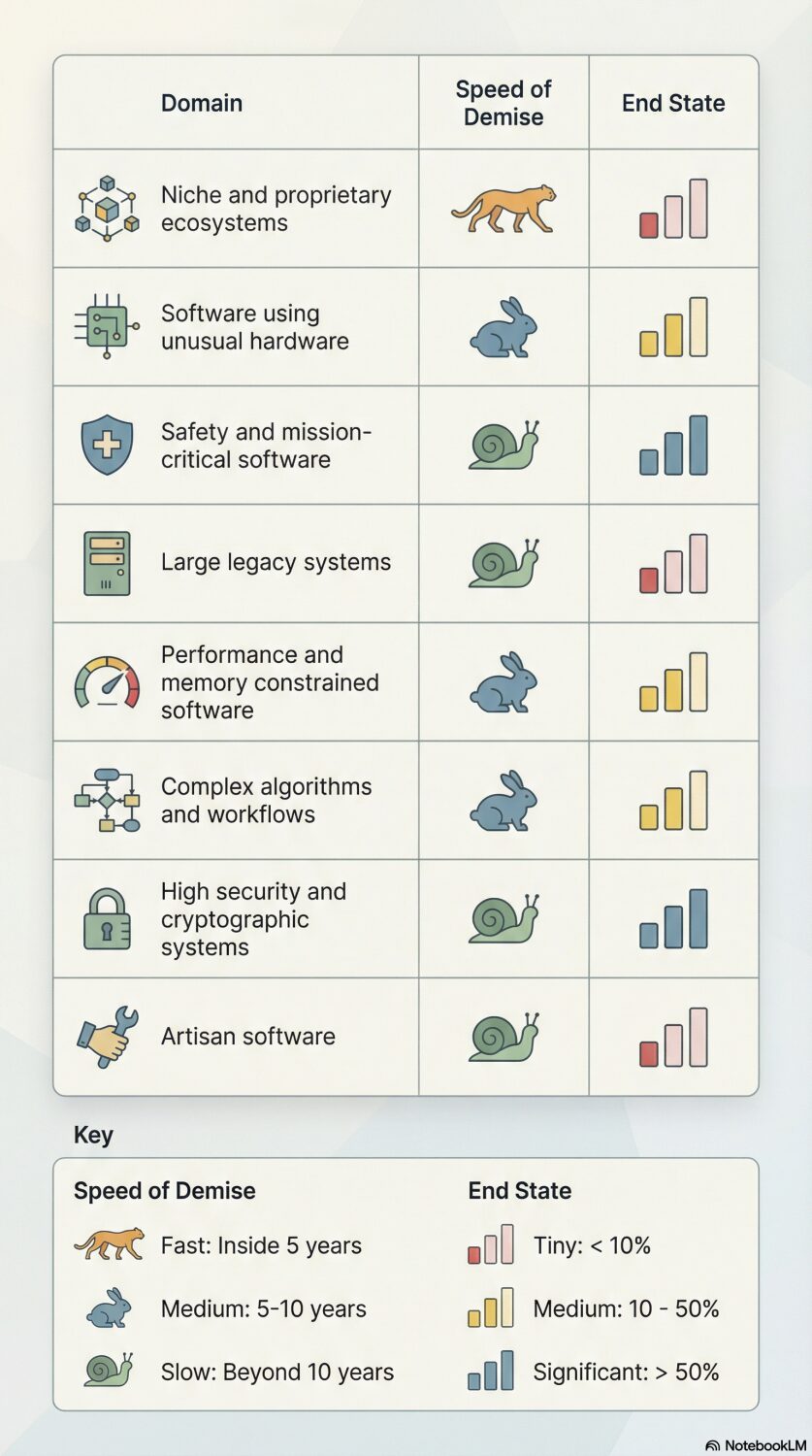
The table shows my guess at the speed and extent of the holdouts’ demise. Each row considers a software system being built from scratch (excepting the legacy row!) and which sits largely in that domain without overlap with the other domains.
The end state describes the volume of hand-coded software that will still be created once the impact of vibe-coding stabilises, stated as the % volume then versus volume today. The speed is how long it will take to reach that end-state. These predictions were formulated using the scientific method of holding a wet finger in the air. To put that another way, they’re a tentative strawman and I welcome your challenge to my guesses in the comments.
My software is in a holdout – can I forget vibe-coding?
Errm, I’d still keep a careful eye on the vibe-coding trends. Sure, being in a holdout is a legitimate reason for your organization to not adopt vibe-coding tomorrow, or to do so very gradually, and that’s fine. But don’t treat that as a “pass”: be wary of using this as an excuse for inaction. I suggest you ask your organisation the following two questions.
Should we still be using other, non-vibe-coding, AI-augmented development techniques and tools? These could be vibe-coding for prototyping, curated agentic creation of human inspected code and test cases, or LLMs for understanding legacy code. In 2026, it’s highly unlikely that you won’t get any advantages from some AI-augmented coding techniques.
Have we analysed our vibe-coding barriers and are they valid? Categorise your barriers to vibe-coding – from my domains above or otherwise – and challenge them. Even better, do some experimentation to explore the possibility of agentic coding in your domain and even on your code base. It’s all too easy for human resistance and organisational inertia to masquerade as plausible sounding technical reasons to not embrace a new technology. To fall into this trap not only “kicks the can down the road”, but risks giving away your advantage when competitors start to easily copy you.
In the third blog in this series I’m going to be taking a look at how the vibe-coding revolution will eventually play out at the software team level. What will it mean for the size and makeup of teams, the skills engineers need, the practices they use, and the way we hire and train software engineers?
I first published this on LinkedIn, where you can join the discussion.