
Use of AI is going to dominate most areas of software engineering. More contentiously, I believe vibe-coded software – where the code is not typed in by hand and has mostly never been reviewed by a human – will also become dominant in production grade development.
Software code will be created 10-100x faster and at 10-100x lower cost compared to today. However, the total cost and time to create a software system will reduce by much less – maybe 2-10x – since software engineering was never about just the code.
The speed of this transition will vary of course. In some domains, it's a revolution with changes that are already underway profoundly altering software development in the next couple of years; in other domains it will be an evolution that takes far longer. There will be some niche areas where vibe-coding won’t take hold, but my prediction is that these will represent a small minority of software engineering activity in ten years’ time.
The size and structure of software teams, the skills they need, and how they collaborate are going to fundamentally change. And this shift will be more significant than any of the shifts since the advent of software; bigger than object-oriented, agile, web, open-source, cloud-first… you name it. The knock on effects on the economics of software and how this drives software industry behaviour will be equally massive.
If you are a software engineer or work closely with software engineers, your world is changing. I’m not suggesting that software engineers are going to disappear, or that Lovable style vibe-coding is the future, or that engineers should adopt vibe-coding tomorrow. But I am suggesting that in 2026 those pondering their software career or shaping future software teams need to plan for this new world.
There’s a lot of ground to cover here, so I’ve broken this into four separate blogs. In other words, when I was writing page 12, I thought, “hmmm, no one is going to get this far”. Perhaps you still won’t, but I hope breaking it down into these 5-minute reads gives you a fighting chance.
- Blog 1. The one you’re reading right now. Why I believe vibe-coding will eventually dominate production grade software, followed by a whistle stop summary of the follow-on blogs.
- Blog 2. Nuclear Plants and Artisan Code: The Last Vibe-Coding Holdouts. An examination of the areas where the status quo software engineering practice will prevail longest and my predictions for how long these holdouts will last.
- Blog 3. Two Person Teams, Syntax Ignorance and Systems Engineering: What Your Future Software Team Will Look Like. A deep dive into the impact this revolution will have at the software team level – the trends we will see in skills, job types and how software engineering is carried out.
- Blog 4. Custom Software Comeback, Breached Moats and the Great Reskilling: The Future of the Software Industry. Predictions on the impact this will have at the industry level – the trends we will see in software companies and the software profession overall.
So let’s start with my forecast that vibe-coding will dominate production grade software in ten years’ time. It’s a view many people don’t agree with.
I heard vibe-coding isn’t for real engineers
If you’ve spoken to software engineers about their use of AI in the last 12 months, they will likely have said something along the lines of, “yeah, AI made writing this piece of code much faster, but some of the generated code was rubbish, and it really couldn’t do blah blah”. Once they’ve told you about the code that was just wrong, and about the time the coding agent followed instructions worse than a ten year old trying programming for the first time, they’ll probably get onto the horror stories about passwords getting accidentally exposed, code bases getting trashed, wrong files deleted, databases being corrupted … The list is long and scary.
Backing up this anecdotal viewpoint, my feed of AI coding news contains more vibe-code doubters than cheer-leaders – I reckon the nay-sayers outnumber the enthusiasts by at least two to one. Some are saying that vibe-coding is already dying and there are innumerable blogs laying out the pitfalls of vibe coding. Some highly respected industry voices, such as Martin Fowler’s, expound the commonly held view that it’s great for certain types of software, such as simple apps, prototypes and in-house tools, but unsuitable for complex production grade development. This position is backed up by an academic literature review that forensically dissects the challenges. To be clear, I entirely agree with this view, at least for the vast majority of vibe-coding happening today. But the question has to be: how will vibe-coding improve and how fast?
People are rightly sceptical of the hype coming from the big LLM providers, and especially from those building the coding ecosystems around the LLMs – the likes of Cursor, Windsurf, Sourcegraph, Replit, etc. have an obvious interest to promote their product. Seeing clearly through the excited, vague, unevidenced claims isn’t easy.
All in all, there’s something of an anti vibe-coding backlash going on.
The vibe-coding rays of hope
So why, as someone who tends to be sceptical and definitely anti-hype, have I concluded that vibe-coding is going to eventually dominate the production grade software arena?
Firstly, it’s noticeable that some highly credible commentators who previously expressed cynicism about vibe-coding’s ultimate utility have been shifting their views in recent months. Andrej Karpathy and David Heinemeier Hansson are two examples. Broadly speaking, the vibe-coding approach (originally named, but not exactly endorsed, by Andrej Karpathy) and the agentic workflows approach (originally advocated by Andrew Ng) are merging. It is this new hybrid approach, which relies on a combination of techniques I describe below, that I think will dominate.
Some of its most visible exponents, such as Geoffrey Huntley and Steve Yegge, aren’t promoting any companies’ products, while contributing to open source and sharing their agent horror stories. In other words, they’re operating in the open and leaning into the numerous risks. Importantly, none of these credible voices are forecasting the death of software engineering. They’re clear that a combination of human engineering skills are still needed; overlapping but different to today’s skills, which is something we’ll get into in the third blog in this series. (As an aside, I’m deliberately ignoring the questionable goings-on with meme coins, because their agentic coding work and related blogs were published before those coins were created.)
As recently as December and January, there has been a collective “a-ha” moment which has led to a step change improvement in agentic vibe-coding results. This relies on a combination of tools and techniques to optimise coding agents:
- LLMs released in Q4 2025; Opus 4.5, GPT 5.2 and Gemini 3 in particular.
- Adoption of the Ralph Wiggum loop to ensure coding agents iterate towards predictable and quality outcomes.
- Better context window engineering techniques to avoid “compaction” and “context rot” (aka LLM forgetfulness).
- Strong validation of code and build steps, combined with test automation that enables AI led test driven development (collectively these validation methods have been termed back-pressure).
- Better agent orchestration that allows agents’ work to be specialised, parallelised and cross-checked.
Predictably, given they’re still wailing from the cradle, these techniques are immature, overlapping, and have multiple competing options. Worse, they rely on tribal knowledge, where the voices providing that knowledge often contradict each other on the best approach. Multiple combinations of LLMs and coding agent frameworks (Claude Code, Codex, Amp, Cursor, etc.) are being used, and to get strong results your recipe needs to carefully combine these with some flavour of the techniques listed. The human engineer still plays a critical role in specifying requirements and making design decisions – software skills which LLMs are not good at and probably never will be – but today the engineer deploying these skills is more alchemist than scientist. It’s wholly unsurprising that only a small number of engineers are playing in this space, let alone getting good results.
Many other tools and techniques need to be developed and matured before vibe-coding becomes suitable for production software. These include coding agents that can:
- refactor and tidy code at higher levels of abstraction;
- develop in safe, sandboxed ways;
- create secure code, designed against known vulnerabilities;
- be driven by specifications that define unambiguous and testable behaviour; and
- fix and enhance features via localised code changes related to the task at hand and without unnecessary updates to the wider code base.
Other tools, beyond the coding agents, also need to improve. For example, for vibe-coding engineers to collaborate on the same code base, version control techniques that cope with far bigger change sets need to evolve. The good news is there are signs of progress on most of these fronts.
By contrast, most early vibe-coding platforms are barely attempting to test the software, code securely, or support non-functional requirements. It’s no surprise that this has given vibe-coding a bad name.
As for the negative experiences of practitioners vibe-coding with agents, they were rarely using a complete suite of these techniques, which means they were vulnerable to the gamut of demented LLM behaviours. This is not a criticism. As I say, all of these techniques are nascent and hard to use. Understandably, developers voice their frustrating experiences of agentic coding approaches first tried a few months ago, when the techniques were at the bleeding edge but are now out of date. Such are the times we live in.
In the meantime, other brave and bruised wayfinders can point to evermore sophisticated vibe-coding successes. Increasingly robust and complex software is being created and maintained while their code editors gather dust – Beads and Claude Cowork are two examples. These aren’t throwaway pet-projects or prototypes – they are already being used by thousands of users in enterprise settings. Complex systems, which took tens of thousands of engineering days to create, such as the Charm TUI Ecosystem and Nomad and Tailscale, have had polished replications created in a few days by coding agents.
Away from the practitioner coal-face, academics are also proposing theoretical frameworks to improve agentic coding. Once you peer through the academic jargon there’s obvious overlap with what Huntley, Yegge and others are discovering in the wild.
Two things are indisputable: when software is built this way it requires fewer people and is far quicker. The tooling costs aren’t trivial – I’ve seen estimates of token usage in the range of $50-$200 per day to develop this way – but these will drop and they’re already negligible compared to the salaries of 10+ engineers for several months. Once comparable quality can be achieved, the economic pressure to build software this way will be unstoppable.
Still not convinced?
When discussing a vibe-coded future, three counter-arguments crop up time and again.
- The code will be a bloated mess; no-one will be able to maintain and fix it, let alone add new features. I think we should break this problem into low-level and high-level technical debt. High level technical debt – i.e. the design and architecture – might be addressed to some extent by agentic simplification and refactor tools, but human oversight of the design will continue to play a major role. I worry much less about low-level technical debt. Yes, a lot of the code will look like a mess to the eyes of today’s developers, hard to read and understand due to boiler-plate and repetition. However, how much will this matter? Does the thought of a hero engineer needing to rapidly fix an emergency production issue by digging around in source code which no-one understands make you nervous? This scenario projects today’s methods onto the future. Instead, your friendly agent will be vibe-coding and validating the fix, using human-updated agentic guard-rails / specifications and agent updated tests. No doubt there will be times – as there already are today – when organizations get burnt by being unable to produce an emergency fix, but techniques for system specification and observability will evolve to ensure agents can make the fix and reduce the chance of that happening. Eventually, the fix of a code-agent will nearly always be quicker and cheaper; and won’t involve overtime, nor complaints about fixing code at 9pm and running out of pizza.
- It will be hard to build software that meets subtle non-functional requirements. I suspect that engineers will eventually get much better at defining and meeting non-functional requirements. Why? Because if you can define then measure or observe the requirement (e.g. protection against known security vulnerability, performance, scalability, code volume, auditability, accessibility) then you can have a code agent build and optimise for those requirements from the start. These requirements will become part of the “back pressure” that always guides the agents. In time, meeting such requirements will involve much less work than it does today, so it will be far less likely to be bolted on late in the day as after-thought engineering.
- What about recursive self-training, when LLMs are increasingly trained on code of unknown provenance also written by earlier LLMs? Well, multiple people have demonstrated using coding agents to create new programming languages, compilers and standard libraries, and then to build new applications in a language that the LLM was never trained on. This suggests that depth of training on particular syntax or libraries is not a fundamental barrier to agentic development.
Sure, right now multi-agentic, minimal human-in-the-loop vibe-coding feels like an unholy, unsafe, unpredictable process – the coding wild-west, herding agent cats, Gastown… These metaphors aren’t unfair and vibe-coding certainly doesn’t have a “proper engineering” vibe. This is why there are probably more people being frustrated and burnt by it than smoothly getting the software outcomes they want. As Kent Beck puts it, we’re in the “horseless carriage” era of the motor car, where something big is happening and no one has fully figured out where it leads. For a while humans will stay in the review loop, just as people waved red flags in front of those horseless carriages.
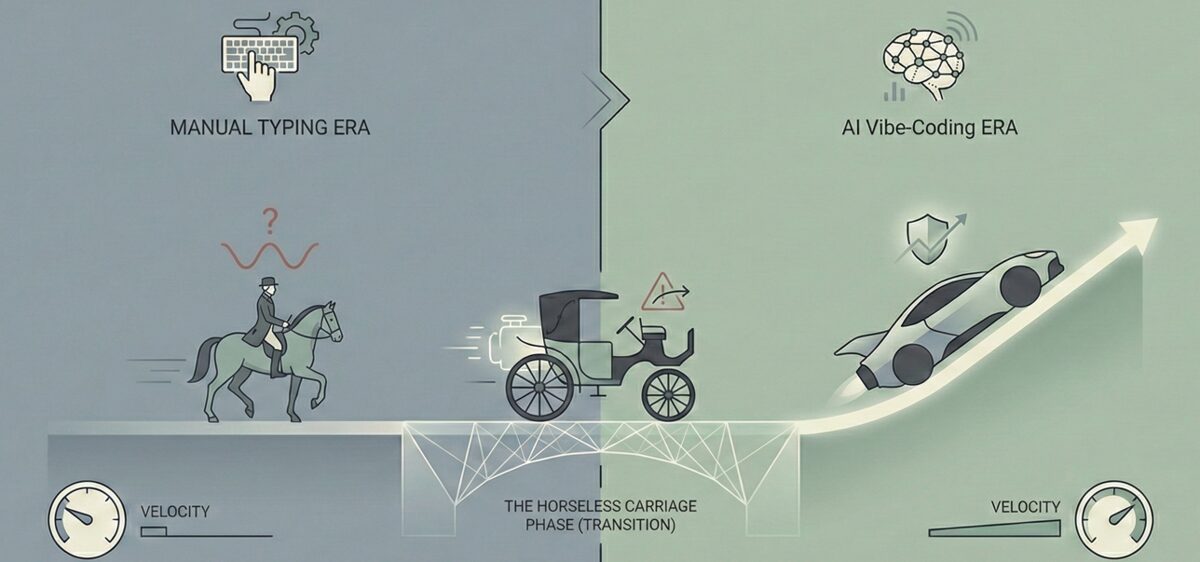
But here’s the thing: the wayfinders are addressing the problems one-by-one, finding solutions and working out how to reliably and repeatably build working, secure software this way. The direction of travel is undeniable, as is the acceleration. Most importantly, the brave few are creating real-world examples of useful, complex vibe-coded systems. Today, there may be very few “high-priests” who have mastered the magic incantations to successfully control a tribe of disobedient, hallucinating, forgetful, inconsistent coding agents to create software that is secure and high quality. But it clearly can be done: the skills can be learnt and the benefits are massive. So the cult will spread and start to look more and more like robust engineering.
Will vibe-coding happen everywhere?
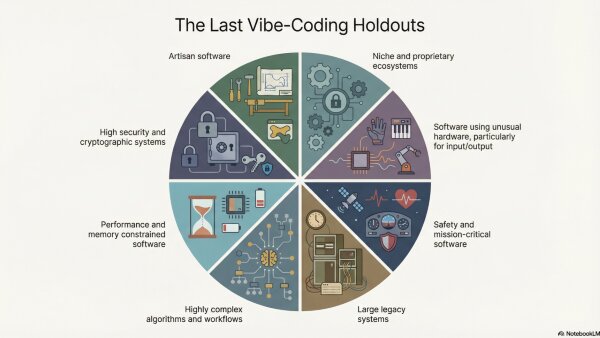
No, it won’t. In the following areas human eyeballing of code is going to be around for much longer, perhaps forever in some cases.
- Niche and proprietary ecosystems
- Software using unusual hardware, particularly for input/output
- Safety and mission-critical software
- Large legacy systems
- Highly complex algorithms and workflows
- Performance and memory constrained software
- High security and cryptographic systems
- Artisan software
In blog 2, I’ll examine each of these holdouts in more detail, forecasting how big they’ll be in the future and how long they’ll hold out for. For now, I’ll say that some of these are very good grounds to put off embracing agentic vibe-coding, but others not so much. If you build software in these domains you should consider these grounds carefully.
What will the impact be?
For most software domains, however, you need to imagine a world where the creation of software is 2-10x cheaper and faster. We might disagree about when this happens and the size of the gain, but you’ve got to acknowledge it’s at least a possibility. What would this mean for your software team and for the software industry as a whole?
Here’s a brief taster of the impacts I predict.
At the software team level we’ll see the following trends.
- Software teams will shrink dramatically and for the same software “output” you will have fewer engineers in your organisation.
- Software engineering skills will change radically, but remain vital. Systems thinking, design, orchestration and product management will be more important than ever, while detailed knowledge of particular languages, syntax and libraries will be less valued. The way you hire and train your team will need to change accordingly.
- Software practices and software development lifecycles will evolve with far greater emphasis on time spent specifying requirements, intent, architecture and validation, while other, dearly-held practices will largely disappear.
And at the industry level I predict the following:
- Some software companies will fail because they can’t sustain their competitive advantage – i.e. their “moats”.
- The calculus of “buy vs build” shifts towards build, again threatening some vendors but increasing in-house bespoke engineering (which will sometimes be regretted).
- More bespoke software will be built, as well as software for more niche tools and tasks that were previously not worth addressing. Globally the total volume of software written will increase. This will counteract the reduction of team sizes to mean that the overall decline in software engineer numbers will be modest and gradual.
- The software industry will undergo the biggest re-skilling it has seen, which traditional training and education pathways will struggle to support. The generalist software engineers who adapt will be highly sought after, while those that don’t will struggle.
These two sets of trends will be explored in more detail in blog 3 and blog 4 respectively.
In the meantime, I’d love to hear your predictions on the extent and speed of agentic vibe-coding adoption.
PS. In case you’re wondering, no LLMs were harmed in the writing of this blog, but Gemini 3 and NotebookLM were used to expand and analyse my sources, to create the infographics and to suggest the title. You may have noticed that NotebookLM is American, using “skeptical” rather than “sceptical” in the blog’s title picture!
I first published this on LinkedIn, where you can join the discussion.