
This final instalment of my series moves from the "how" of the software team to the "so what" for the global software industry. When agentic AI and vibe-coding make building software 2x - 10x cheaper, the economic shockwaves won't just rattle the dev shop; they’ll be felt much wider.
I see a few major themes developing:
- Many software companies fail because their competitive advantage disappears.
- Software companies won’t compete on development costs.
- The “build vs buy” pendulum will swing towards build.
- Much more software will be built.
- Software licensing models will be radically rethought.
- There will be massive industry wide reskilling.
I’ll end this blog with perhaps the most important question. What will this mean for software jobs? Will there be mass layoffs of software engineers or a burgeoning demand for software skills that enable organisations to realise software value in brand new ways?
The great moat breach
For decades, the "moat" around many software companies was often the sheer volume of code they had managed to pile up. It was simply too expensive and too slow for a competitor to replicate those thousands of features.
That moat has been breached. Pure-play software companies – or those that derive the majority of their revenue from software – are entering a period of existential risk. If your competitive advantage is "we have more lines of code than the other guy," you are in trouble. Polished replications of complex systems – Next.js being one recent example among many – have already been created in just a few days by coding agents.
Woe betide those who rely on software functionality being "too expensive for someone else to build". To survive, companies need moats that are harder to copy: deep domain expertise, rich and valuable proprietary data, established distribution channels, or rock-solid industry relationships. Perhaps software patents and copyright will offer some defence, but the ability to detect and prevent intellectual property infringement is only going to become harder in the vibe-coded world, regardless of what you think of the ethics of that situation.
Organisations rarely compete on software development cost optimisation
Once an organisation is AI-native, the cost of creating the code represents a much smaller proportion of its cost base. The wage bill of your 50 developers and testers is a big driver of profitability today, but much less so when you employ 4 AI-native software engineers and your software development and ownership costs are dominated by the costs of your product management, customer support, AI token usage and platform infrastructure. When the wider business costs of sales, marketing and other operational overheads are factored in, the software development costs rapidly become marginal. In this new financial reality, off-shoring or near-shoring development will provide little to no competitive advantage. Building the right software and building it well will be far more important than building it cheaply.
The return of bespoke: build vs. buy
The calculus of "buy vs. build" is swinging towards build. When the time and cost of bespoke software designed just for you drop significantly, "rolling your own" becomes an intoxicating prospect.
This in turn will lead to a reduced market for reusable off-the-shelf software libraries and software tooling: the recent stock market dips or SaaSpocalypse points to the nervousness around this prospect.
However, there is a trap here. In a world where building is cheap, it is far too easy to "concrete in" your existing, inefficient practices rather than reimagining your workflows. Anyone who has worked in digital transformation knows the value of the "forced rethink" that comes with adopting off-the-shelf software, often flying in the face of stakeholders who prefer to customise software to fit existing workflows. Organizations that overplay the build card risk being saddled with technical debt and the cost of in-house staff who aren't serving the core mission. Does it really make sense to keep a full time engineer on your payroll whose role is to constantly update and test your in-house customised CRM? Agentic coding enables the rapid addition of features and UI changes, sometimes resulting in users unable to keep up with constantly changing features, feature bloat, and UI complexity. Making it easy to change software doesn’t make it easy to change well.
Despite these traps, I still think the pendulum swinging towards build is inevitable, even if there is a later correction.
The death of the "per-seat" licence
Traditional software licensing models are facing a crisis. As many white-collar and operational roles are supported or replaced by AI agents, what happens to the software those humans were using? All of a sudden, the expensive financial management software that was being used by 20 book-keepers is now being accessed by one manager and an agent. If your revenues are based on per-seat licensing this is a massive problem. Now you need to somehow charge in a manner that reflects the value and usage of software, which sounds easy enough but is surprisingly hard in practice. Ironically, the AI industry’s own token-based pricing is a precursor here, even though token usage is often only loosely tied to actual value.
The software volume explosion
Don't mistake software efficiency for a shrinking industry. The total volume of software written is going to skyrocket. By "volume," I don't mean lines of code, but units of meaningful software value created in the world. Here are some of the drivers of this increase:
- Roll-your-own. As we saw above, there will be a lot more duplicated or similar software because customising it via building in-house is going to seem much more attractive.
- Scratch-the-itch. Because building is cheaper, people will create short-lived or narrow-purpose software tools that previously weren't worth the investment.
- New AI-driven classes. Entirely new categories of software will emerge, further driving software creation.
- Integration scaffolding. There will be a massive increase in demand for the software "scaffolding" that allows AI agents to effectively operate within existing systems previously driven by human workers. Think of this as the software that enables the red line to become the blue line in the diagram below from Anthropic’s report on the labour market impact of AI.
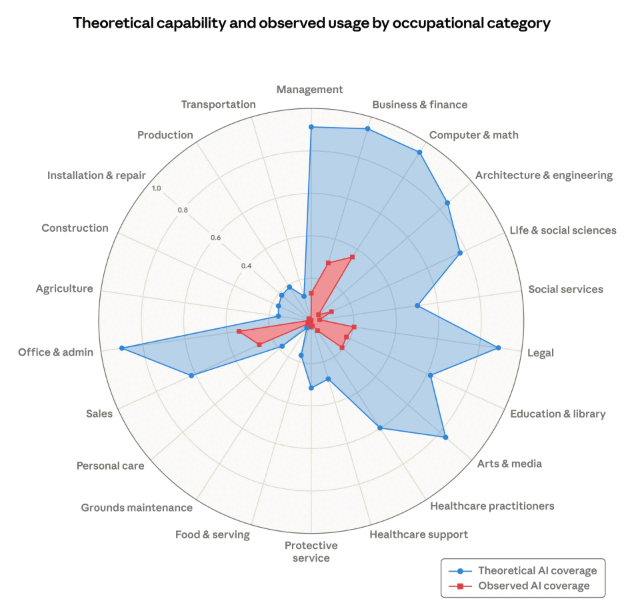
The economists among you might recognise something of Jevon’s Paradox in these points – this is the effect where increase in efficiency of a resource (in this case the labour to build software) leads to an increase in the demand for the product (software) by a bigger multiplier than the efficiency gain. Nobody knows the extent to which this will be true for the effect of AI on building software, but I’m very confident that overall software volume will grow.
Sadly, open source software will suffer against this backdrop. Projects will likely fragment as it becomes trivial to copy and build variants. Combined with larger, AI-generated pull-requests, being an unpaid OSS maintainer will be an increasingly thankless task.
The great reskilling
The skill changes inside the software industry – described in blog 3 – will be seismic, bigger than those seen for agile, web, cloud, mobile. In an industry that employs over 50 million people worldwide, how will this reskill happen? I don’t think via dedicated training providers, third party consultancies, universities, or structured employment training schemes and apprenticeships. Sure, all four of those will update their offers, make some noise and make some money. Anyone remember when blue-chip consultancies realised that agile was more than a passing fad and started offering all kinds of agile services having read the idiot’s guide ten minutes before you did? But they won’t move fast enough to stay up to date; traditional training approaches are built for a world where skills change significantly every 3-5 years, not every 6 months. Moreover the ability for LLMs to create and deliver highly customised and interactive training at a fraction of the cost has changed the dynamics of training provision.
No, the “great software engineer reskilling™” will reward individuals and teams with the curiosity and self-drive to learn, experiment and keep-learning. In some ways, this will be more meritocratic: those with privileged access to education and training will be less advantaged, and this was predicted by Gartner’s survey of engineering leaders last year.
Gartner predicts that GenAI will enable 40% of software team members to come from nontraditional software engineering or technical educational backgrounds by 2028, up from 20% today.
The future of software jobs?
So, the million-dollar question: what does this mean for jobs? While build costs may drop by 2x - 10x, the reduction in roles will likely be modest or zero in my view due to the big increase in software volume. If you read Anthropic's labour report linked above, the eagle eyed will notice that the US Bureau Labour Statistics currently predicts an ~16% increase in software developer roles. This seems counter-intuitive, but I certainly think it's more likely than a nosedive in software jobs.
Whatever the trend is, it will play out over years, not months. Yes, fast moving companies can realise job reducing efficiencies today, but this is the exception, not the rule. In most organisations, inertia (“old habits die hard”), domains being unsuitable (vibe-coding holdouts), poor adoption (technical debt from “AI slop”), and workforce unreadiness (not enough AI-native engineers) will act as a natural brake on the transition.
I believe the biggest threat to software practitioners in the coming years will not be the decimation of jobs, but the need to reskill and generalise to stay relevant.
I first published this on LinkedIn, where you can join the discussion.