
As agentic coding increasingly dominates how software is built, software teams will change radically. Those who read my first blog in this series will know that I believe software engineering skills will remain important and will be both specification driven and test driven. To put that another way: the focus shifts from "how do we build this?" to "what exactly should we build?" and "how do we know it’s right?". This will be a world where fewer people build more software, more quickly, with very different skills and practices.
Within this, I think we’ll see the following key trends:
- Software teams will shrink dramatically
- Software engineering skills change radically, but remain vital and in demand
- Product management and user design become central and highly sought after
- Most software development lifecycle practices will change, a minority will remain
- Testing will be primary and also unrecognisable
- The entry-level job market remains tough and learning pathways are non-existent
Let’s dive into each of these.
Software teams will shrink dramatically
While there have been breathless headlines suggesting software creation will become “free”, I’ve not seen any credible commentators claim that software engineering will disappear. The message isn’t “you’re not needed”, but it is “your job will evolve”.
For many classes of software product, teams of one or two software engineers supported by a product manager will be adequate. Coding, code reviews, debugging, automated testing will all dramatically speed up by 10x or more, which is why there will be fewer software engineers and testers needed. Other roles – including product management, user experience design, business analysis, etc. – will be made more efficient by AI, but not by the same multiplier.
The chart below shows the person-days spent on different activities in the SDLC for a “typical” small enterprise development project in two different scenarios. The first scenario, “Traditional”, could have been in 2023. The second best-case scenario, “Future”, is where agentic coding has reached a maturity with very little eyeballing of the code, the codebase is well suited to agentic coding (not a vibe-coding holdout), and the team are experienced AI-natives. In places this is happening today, but many teams won’t reach this level of efficiency anytime soon.
Obviously, there are as many software team sizes, shapes and role mixes as there are software projects, so this is purely illustrative – it’s not intended to be universal!
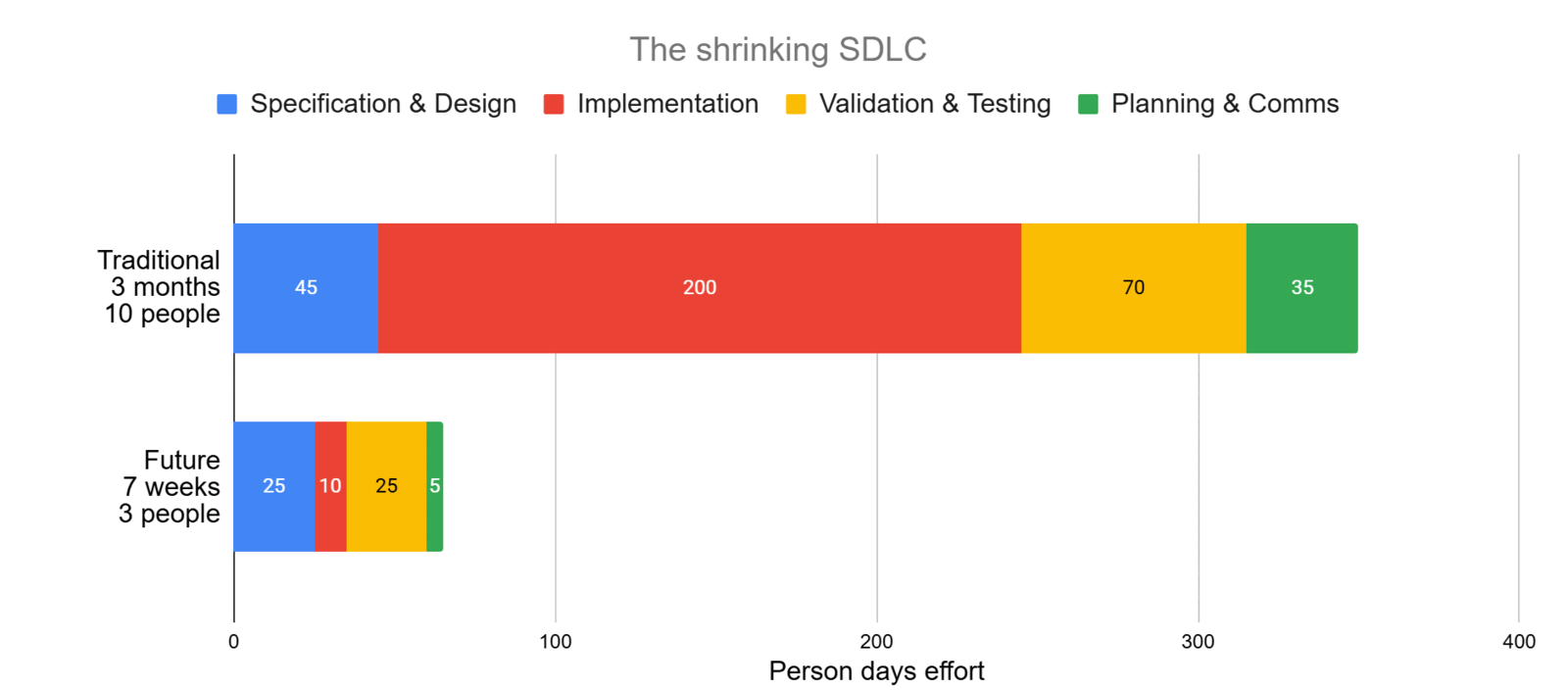
For this particular example the headlines are:
- Total build cost is reduced 5x.
- Team shrinks from ten to three
- The delivery time is almost halved.
| Traditional: what was involved? | Future: how does it change? | |
|---|---|---|
| Specification & Design | Capturing requirements, user & stakeholder research, UI design, product management, analysis, stories. System architecture and tech design | Intent definition in agent friendly specs. Similar levels of user/stakeholder engagement and requirements analysis, done more efficiently due to AI assisted design, fast prototyping and quicker feedback |
| Implementation | Coding, unit tests, code reviews, debugging and fixing. IDE focussed | Very little time spent in IDE. Agent orchestration and systems engineering |
| Validation & Testing | Writing tests, creating test frameworks, executing tests, managing CI/CD | Automated validation & tests written by agents (so much quicker), but coverage greater (hence modest reduction in total effort). |
| Planning & Comms | Project management, ceremonies and meetings, documents, coordination and alignment | Team is smaller, timescales are reduced, fewer meetings, way less coordination overhead |
| Team structure | 1 product manager / designer, 1 delivery manager, 6 software engineers, 2 testers | 1 product manager / designer / delivery manager (combined), 1 software engineer, 1 software engineer (test focussed) |
The effort reduction will vary wildly between projects, organisations and domains; as will the time taken to achieve the improvement. But I think the 5x reduction is a reasonable average yardstick for where most projects will be in 5 years’ time.
So for the same software value output, there will be fewer software engineers and testers in your organisation or department. Since the expectations – and often the market imperative – will be to build software more quickly, the headcount won’t reduce 5x. Also, as I’ll point out in my next blog, I believe much more software will be created overall, so you can’t necessarily conclude that software engineering headcount in your organisation will contract.
Software engineering skills change radically, but remain vital
There are a lot of views out there on what future software engineers will need to know. Here are two that I found compelling.
There’s a new programmable layer of abstraction to master in addition to the usual layers involving agents, subagents, their prompts, contexts, memory, modes, permissions, tools, plugins, skills, hooks, MCP, LSP, slash commands, workflows, IDE integrations, and a need to build an all-encompassing mental model for strengths and pitfalls of fundamentally stochastic, fallible, unintelligible and changing entities suddenly intermingled with what used to be good old fashioned engineering.
Anthropic’s 2026 Agentic Coding Trends Report gives a good summary in its “Trend 1”:
Evolution of abstraction: Most of the tactical work of writing, debugging, and maintaining code shifts to AI while engineers focus on higher-level work like architecture, system design, and strategic decisions about what to build.
Some of the key skill themes emerging are:
- Intent definition. Do you understand the user needs and business domain to articulate what a product should do? Do you know where to draw the line between over-specifying the implementation and allowing agents to propose features and solutions?
- System design and review. Can you turn a fuzzy product idea into a series of prompts and specs that produce well-architected, composable, testable modules? Do you have the judgement to identify when the architecture isn’t serving its purpose and know how to update the prompts and specs accordingly?
- Agentic orchestration. Can you orchestrate agents and sub-agents to work effectively in parallel, not just to write code, but to conduct code reviews, to create tests, to carry out refactoring and to run Continuous AI?
- AI-output review and refactor. Can you understand what is being built at the appropriate level of detail to be confident in the agent’s design and source-code? Do you know how to remain the captain of the ship and keep the agents on track, without getting lost in too much detail?
- Risk and cybersecurity. Are you clear what the data protection, compliance, security and other risks of your product are and how they could be compromised? Do you have sufficient risk and compliance agent guardrails in place that the code is secure and that vulnerabilities will be surfaced?
For me, the single most important trait that software engineers need at the moment is curiosity. A willingness and drive to learn is critical, as is the persistence to experiment and try out new ideas. New agentic tools and practices will come and go, so what will set the best engineers apart is the ability to quickly adopt improved tools, and to drop those that are no longer optimal.
Knowing languages, syntax and frameworks will be far less valuable. Learning other techniques will be crucial; but where to focus? Not all the skills listed by Karpathy will endure; for example the efficacy of MCP is being increasingly questioned. So software engineers should focus on learning durable concepts, such as architecture patterns, specifying intent clearly and systems thinking; then applying them to build working software, while avoiding getting too bogged down in the usage details of the latest tools.
There will be increasing pressure for software engineers to understand the business domain deeply, to engage with the business stakeholders and users, and to own the business outcome. Without this ability, they will be ill-placed to define intent and keep coding agents on track.
Overall, the software engineer role will be elevated, with a wider remit and focus on the bigger picture. Software engineers will gradually be expected to take on responsibilities of other roles, which we will explore in the later key trends of this blog. Their influence on product success and business outcomes will increase, which is both an exciting opportunity and a daunting challenge.
The market seems to coin new job titles every so often that encapsulate market hiring trends; think cloud engineer, full-stack developer, or DevOps engineer. I’m not sure what the agentic coding hiring terms will be – “Agentic AI engineer” doesn’t exactly roll off the tongue – but I predict that they’re coming.
More importantly, organisations will need to hire differently for these new skills. For some time, smart organisations have placed less emphasis on experience of specific language and frameworks in their job specifications; i.e. gobbledygook acronyms. Instead, they have been looking for evidence of generic transferable software skills. Agentic coding hiring will double down on this trend, with organizations increasingly hiring for aptitude, curiosity, drive and self-learning. Recruiters and hiring managers will look for experience of agentic coding tools of course, but equally important will be the ability to evidence private passion projects or solo professional projects where candidates can specifically identify their individual contributions and are able to articulate how they acquired the necessary skills.
Simon Greenman puts it like this:
Hire for systems thinking, not syntax. Organizations that recruit for just initial speed will amplify AI’s weaknesses; those that hire for judgment will amplify its strengths.
Product management and design become central and highly sought after
As the “code creation” bottleneck shifts to focus on intent definition, it will be evermore important to understand business needs from stakeholders and gather rich user feedback. This requires user centred design, product management and customer support insight.
The market will demand this focus. Products will increasingly differentiate based on superior user experience or better customer service, as simply having the most features will no longer be a sustainable advantage in a world of much cheaper software development. Competition will focus on the quality of what you build, not the cost of how you build it.
Consequently these roles will become a bigger proportion of your cost base, leading to a higher product manager to engineer ratio. I’m sceptical of Andrew Ng’s forecast of a 2:1 ratio, but I entirely agree with the trend he’s identifying.
Product managers will become the product navigators of the vibe-coding era, but I don’t think their value will come from them writing user stories or long requirements documents. Instead, they will become experts at expressing product intent directly in spec driven ways that agents are optimised to interpret. This is a fast moving area, and I strongly expect the form that products and features are described to agents today will evolve considerably – I doubt we’ll be writing PRD.md files or using SpecKit in the long term. Does this sound like the return of “waterfall” to you? In a world where it’s possible to specify, prototype and get feedback on a rich product in hours and then rapidly iterate, I’m not sure it matters. Is that big-up-front-specification-and-design or just sensible?
Product managers and designers will be empowered to prototype features themselves to help elucidate workflows and detailed look-and-feel. These prototypes will have richer levels of interactivity and workflow fidelity than is possible with today’s wireframing tools, leading to better quality definition and early feedback. Just as software engineers will pick up product management skills, the reverse will be true and some product managers will create production grade software. Nevertheless, prototyping shouldn’t be confused with the deep systems engineering and agent orchestration needed to create production grade software in more complex systems.
I forecast that the role of a product manager will often merge with that of the delivery manager or project manager. Project management won’t disappear – understanding timescales and costs still matters – but it will require much less effort when teams are smaller and projects shorter.
Most software development lifecycle practices will change, a minority will remain
Many existing software engineering concepts have evolved to enable human developers to do their job better. Today we evangelise the importance of adhering to principles such as readability, maintainability, reuse, modularity, abstraction, whitebox testability and continuous integration. These principles are realised using practices like style guides, source code documentation, code reviews, linting, reducing technical debt via refactoring, using third party libraries wherever possible, object oriented languages, micro-services, use of clear interfaces, mocks and contract testing, and dedicated continuous integration tooling, environments and schedules. If most software code becomes like assembler today (i.e. never looked at by the vast majority of software engineers), how will these approaches change and which will die? Some are obviously redundant – style guides for examples – but others related to design, architecture and systems-thinking will morph and remain important rather than disappear.
What about agile? My view is that the agile manifesto and the twelve principles behind it are as relevant as ever in a vibe-coded world. However, many agile “implementations”, such as XP pair programming or certain Scrum ceremonies, seem unlikely to persist in their current form. Optimising human interaction and understanding will change when teams are smaller and can demonstrate fully functioning software more quickly. Do the daily standup, retro and sprint demo still make sense? Maybe they do in some ways, but their format and cadence will change. What is clear is that one of agile’s key tenets – iterating rapidly and getting constant user feedback – makes even more sense when combined with vibe-coding.
One of the hardest aspects of software engineering is scaling teams. Getting 100 people to effectively collaborate is way, way harder than a team of 5 to 10 people. There is a whole sub-industry (and not a few bruised practitioners!) offering “solutions” to this, such as SAFe, LeSS, etc. I don’t believe these team scaling practices are going to survive. Instead, they’re going to be replaced by a different set of practices that allow a handful of engineers to generate the same quantities of code for large systems without tripping each other up. This is already creating a merge conflict nightmare for teams at the bleeding edge of agentic coding. Architectural and source-control techniques will evolve to address this.
I’m certainly not saying most software engineering principles will disappear overnight and I’m equally sure some of our dearly held principles will remain important. Here are three “keepers”:
- Some flavour of strong version control will remain essential. What’s kept under version control will become its own topic – specs, source code, LLM targeted languages such as CodeSpeak, …? The issue of agents creating massive conflicting change-sets will also drive the evolution of version control tools.
- Observability, the art of using logging and telemetry effectively and systematically, will become more important. Initially used to help humans understand system behaviour, observability will be even more critical when the consumer changes from human to agents, and is used to drive not just diagnostics but agentic coding.
- The state of the art in test automation will evolve rapidly. This trend is so significant that I think it deserves its own section.
Testing will be primary and also unrecognisable
In an agentic world, the role of testing is sovereign because it will define the canonical truth of what coding agents should write.
Andrew Lau captures this well:
Testing is a particularly interesting frontier. You cannot fully automate quality without defining “truth,” and many legacy systems lack that specification. That is a blocker for full-scale AI transformation. We will need new ways to formalize intent, essentially redefining how “correctness” is expressed.
Testing approaches will mainly be automated. The test frameworks and the tests themselves will be designed, implemented and reviewed by agents. Code agents have already shown good success at adding tests to existing test suites. Certain types of testing – such as chaos testing and input validation – should be very well suited to analysis and implementation by LLMs. In general, the ability of LLMs to increasingly understand test coverage and system risk should lead to much better prioritisation of test creation and greater test coverage. A shocking number of system and integration tests in the wild today have unknown and woefully incomplete test coverage, usually resulting from tight schedules or lack of money. Such scenarios will become much rarer for high value or high risk software.
Just as software engineering skills will radically evolve, so too will testing skills: the tester will become the agents' partner, prompter and orchestrator with their job focussing on checking that the agents are creating a thorough and correct test eco-system. Test and developer roles will increasingly merge and the proportion of time thinking about test approaches and test coverage will increase. For the most part this will be a good thing as software engineers become more quality focussed and aware of overall system behaviour. However, one accidental advantage of traditional developer/tester separation is that it requires at least two independent human interpretations of a set of requirements and often this highlights ambiguity. Techniques will evolve to ensure the agents creating the tests and the agents writing the software operate as independently as possible and are encouraged to question the software engineer where ambiguity exists.
Today the nature of the testing approach is largely dictated by cost and risk. A surprising amount of system testing is manually executed for three main reasons:
- The effort to fully automate is too expensive to justify the benefit, which is often true for low risk systems.
- Human system testing – particularly when exploratory in nature – often uncovers bugs and issues that are “off the path” of the test case and wouldn’t otherwise be identified.
- The nature of the system – one with unusual input and output devices, say – doesn’t lend itself to test automation.
I believe that the first two points will greatly diminish as AI testing agents improve, massively reducing the cost of doing the work, while also eventually improving the test coverage and quality. The additional benefit of this test automation will be that it becomes a fundamental guard rail for keeping the coding agents on track, in a way that wasn’t the case for enabling human developers. For this reason, I think the drive to automate testing even for the difficult cases – e.g. using digital twins, mock systems, or sophisticated test harnesses – will be evermore relentless as the costs reduce and the benefits increase.
The entry-level job market remains tough and learning pathways are non-existent
So, if you’re a software engineer today, how long does it take to master the skills of agentic coding? Steve Yegge talks about 1000–2000 hours of experience being required to achieve fluency, which equates to 6–12 months of full time usage for an already experienced engineer! But don’t despair, this will become quicker as the tools improve and the choices are clearer. It’s hard to journey through the wild-west when you’re a first settler; much quicker when the roads are built with towns en-route. The vibe-coding ecosystem and tooling will become more polished with greater consensus around good practice. We’re currently witnessing an AI coding ecosystem evolutionary arms race with many candidates striving to be among the “survival of the fittest”. The winners are unclear, but what is clear is that they will be outstandingly productive tools.
All of which begs the question: what’s the most effective learning pathway? I doubt it’s going to be via formal or informal training courses. Sure, courses will be offered, but the only thing you can guarantee is that they will be out of date quicker than you can say, “who has released a new LLM this week?” Perhaps organisations should hire a mentor, someone who has been at the bleeding edge of agentic coding for a while and can teach it to others. That might help, but it’s not enough by itself and that person will struggle to stay ahead working in an organisation with more traditional practices. No, the “great software engineer reskilling (TM)” will reward individuals and teams with the curiosity and self-drive to learn, experiment and keep-learning. The answer has to be to create the culture and the space for the experimentation to happen, which takes me onto people starting out in their career.
According to a report from Stanford University about the effects of AI on employment, generative AI has fundamentally disrupted the entry-level job market. This chart from that report shows that, since late 2022, early-career workers (ages 22-25) in AI-exposed roles have experienced a 13% relative decline in employment.
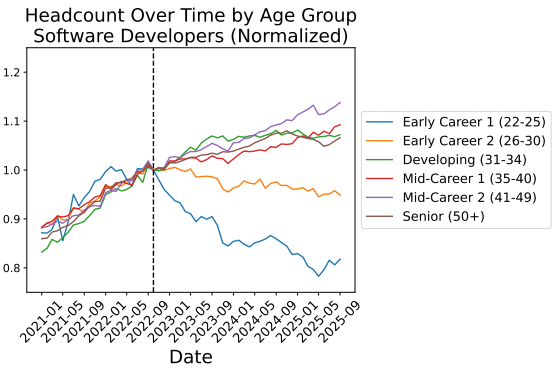
This is largely because AI can now handle the tasks traditionally used to train juniors, such as writing simple functions, unit tests or boilerplate code. Nonetheless, juniors are still being hired and even if there is a reduction of global software engineer numbers, there will come a point where the development pathways must be built to create the software engineers of the future.
I sometimes feel sorry for the folk starting out on that pathway. Here’s what we’ll be asking them to do:
- Understand traditional software engineering concepts, with greater focus around architecture, design and systems thinking.
- Become closer to the business, with great stakeholder skills and ability to understand products, users and their requirements.
- Become more test aware, understanding the approaches and frameworks to ensure quality.
- Learn a raft of new techniques around agentic coding, whose tools change by the time they’ve figured them out the last one.
Ouch: this kind of accumulated wisdom takes many years to acquire. This additional learning isn’t exactly offset by the fact that they don’t need to spend so much time learning programming languages and their syntax.
Hiring juniors was always an investment in the future, and that means bearing a cost while they get up to speed. Kent Beck wrote a great article on this, in which he looks at the productivity curve of a junior hire. This picture is shamelessly borrowed from Kent’s article, with the addition of a green curve:
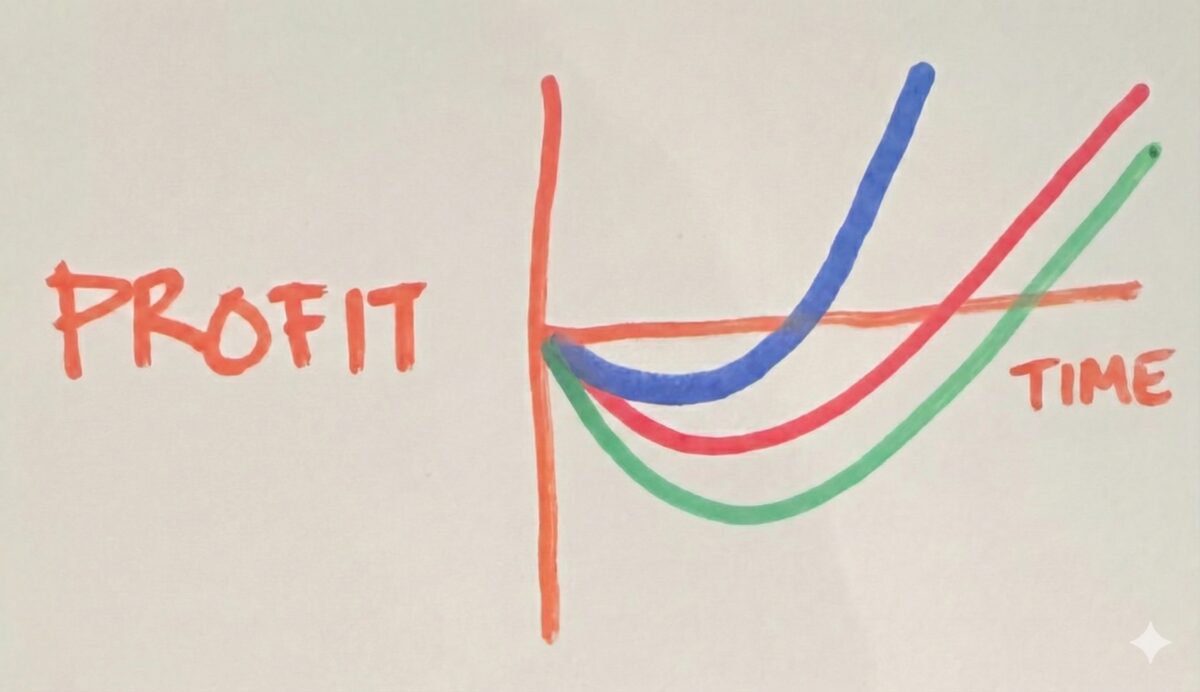
I’m not sure AI will compress the original red learning curve towards the blue curve, as Kent argues. Yes, they’ll be able to produce working software faster, but I think they have a raft of other skills to pick up much sooner than they would have needed to ten years ago, and so the new curve becomes more like the green one – the payback will take longer. Regardless of the curve, I’m convinced that the smart organisations will be those investing in developing agentic software engineers, often via reinvestment of the savings agentic coding is giving them elsewhere.
Let’s circle back to the AI learning pathways of experienced engineers. While their productivity might not be net-negative as they get up to speed, it definitely diminishes. This too requires an investment mindset. The secret will be for managers to actively put aside time for experiments, learning and process improvements that gradually give the whole team the opportunity to reskill. They need to set clear goals and learning outcomes, while accepting that this will lead to short term slow downs for future gains that they can’t afford to miss out on.
These six trends are all individually significant and there will be others not mentioned here. What is unique – at least in the 60 year history of software development – is the speed at which they’re happening and the fact that so many changes are happening simultaneously.
Organisations with large incumbent teams and legacy code bases will struggle the most to adapt, but regardless of your context, the most important advice to those still writing software like it’s 2023 is to roll up your sleeves and start experimenting. Delaying is not an option.
In the final blog in this series, I’ll be taking a look at how these trends will play out at the level of the wider software industry.
I first published this on LinkedIn, where you can join the discussion.