
Earlier this year I researched and blogged about AI-assisted software development, and made some predictions along the way about vibe-coding, the future of software teams, and the future of the software industry.
Then I came out of software development retirement and tried AI-assisted software development for myself. Race Directory is a UK running race search engine, taken to production under a firm rule: I never hand-edited the code. Fifty thousand lines written, none of them read. I've written up what that was like separately – this piece is me marking my own homework.
Sixteen predictions, then. One I'd reword, eleven I'd leave as they stand, and four I'd now say even louder.
The one I'd reword
My bullish view on vibe-coding has softened, mostly because the definition moved under me. "Vibe-coding" is now most often understood as abandoning most enterprise software practice and prompting your way to an app through a wrapped platform like Lovable. I don't see enterprise-grade software happening that way. Not because the code comes out badly - mostly it doesn't - but because practices like systems thinking and architecture remain critical.
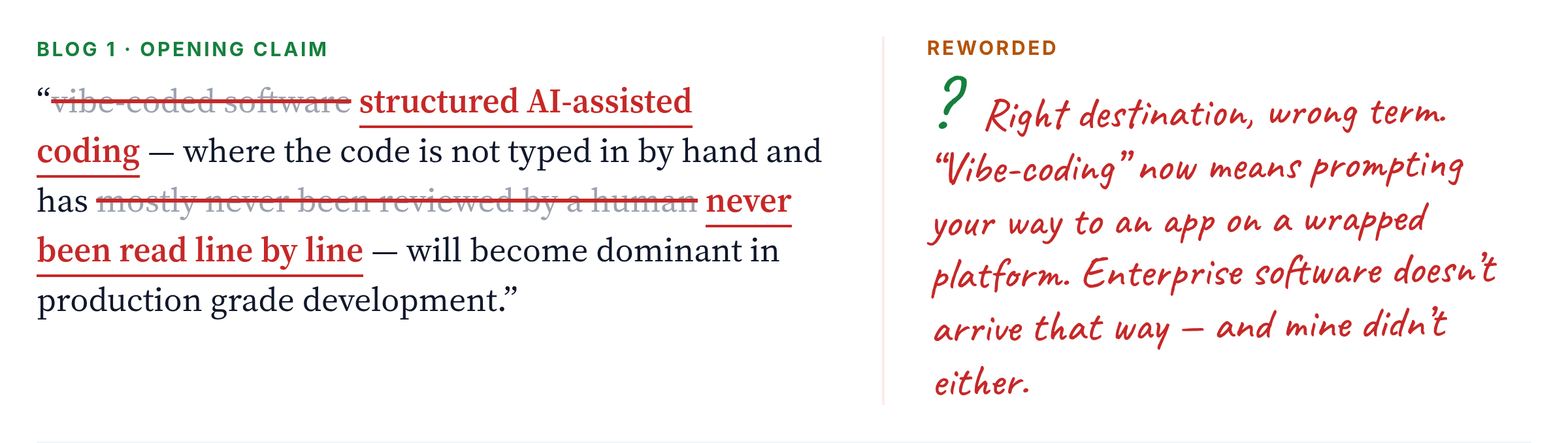
So I'd separate vibe-coding firmly from "Structured AI-assisted Coding" as Addy Osmani and others define it, which is roughly where this project sat. Although "sat" is wrong: it started nearer the vibe-coding end and drifted rightward as the codebase matured. You can see it in the prompt history: about 600 prompts, getting fewer and larger as they moved up to the planning and design level.
What I think I got right was the destination: people will spend far less time eyeballing source code than they do today, and in many cases none at all. Never reading it cost me less than I expected, because the decisions that mattered were in the designs I reviewed and the plans I edited. You'd still be foolish not to review code. But review should be far more targeted: concentrated at the design level, and prioritised on risk rather than habit.
What held
There are two claims I'd leave untouched, because the build confirmed the earlier thinking.
The first is that low-level technical debt matters much less than we think. In January I wrote that a lot of the code would look poor to today's developers, and asked how much that would really matter. Fifty thousand lines later: not much. When something needed changing, an agent changed it, and whether the surrounding code was elegant, contained repeated string literals or missed a simple abstraction was largely beside the point.

The second is the cost claim: code created 10–100x faster and cheaper, but whole system releases only 2–10x, because software engineering was never just about the code. That holds, and it landed nearer the bottom of the range for me. This was my first project, so clearly greater speed-ups are possible. However, those quoting 100x speed-up or "near zero" software costs are conflating coding effort with whole system builds.
What I'd now say even louder
Everything I said about human judgement, I understated.
I wrote that high-level technical debt "might be addressed to some extent" by agentic simplification tools, but that human oversight of the design would "play a major role".
The one code module of mine that suffered – a bespoke agent meant to build and maintain about twenty web scrapers unattended – did so because of an architectural call made in the first week, which compounded quietly into an eleven-thousand-line house of cards. No amount of prompting fluency or code-level review would have prevented that. A design review would have.
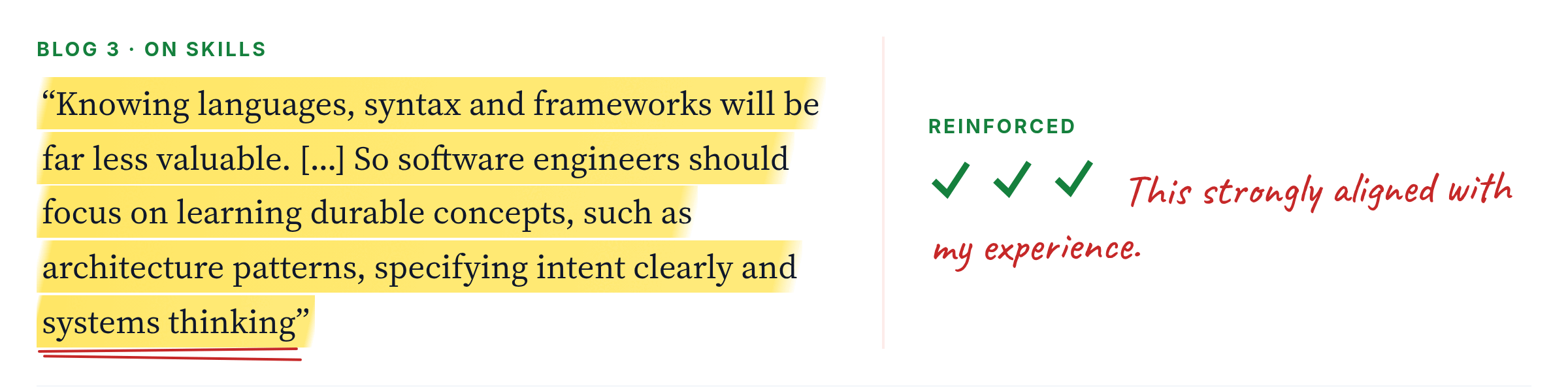
The same applies to the skills claims. Systems thinking mattering more than syntax wasn't a trend I watched from a distance; it was the main lesson the project consistently repeated. And humans staying critical for intent and design turned out to be not a caveat on the story but the main theme I came across in my Claude Code sessions time and again. All the while, three months later, I know as little about React and TypeScript as I did at the beginning. I was expecting that at some point I'd have to lift the lid on the "React for dummies" guide or RTFM on TypeScript, improving my knowledge at least a little, but that really wasn't the case.
The speed ceiling: where the bottleneck actually went
I'm largely sticking with my predictions on the future of software teams: roughly 5x smaller for many classes of product still looks a fair yardstick. But the cap is worth saying plainly.
I felt I was flying early on, then slowed as the codebase matured and new features and user requirements got harder to define and reconcile against the real world. The work was in deciding what I wanted, reviewing designs, and going "oh, hang on" when the side-effects surfaced. That hasn't got dramatically quicker, so the dramatic speed-up of coding implementation and testing has a bounded effect.
Testing went further than I predicted too: around 2,500 test cases, every one written by an agent, and the suite rather than the code became the thing I trusted the most.
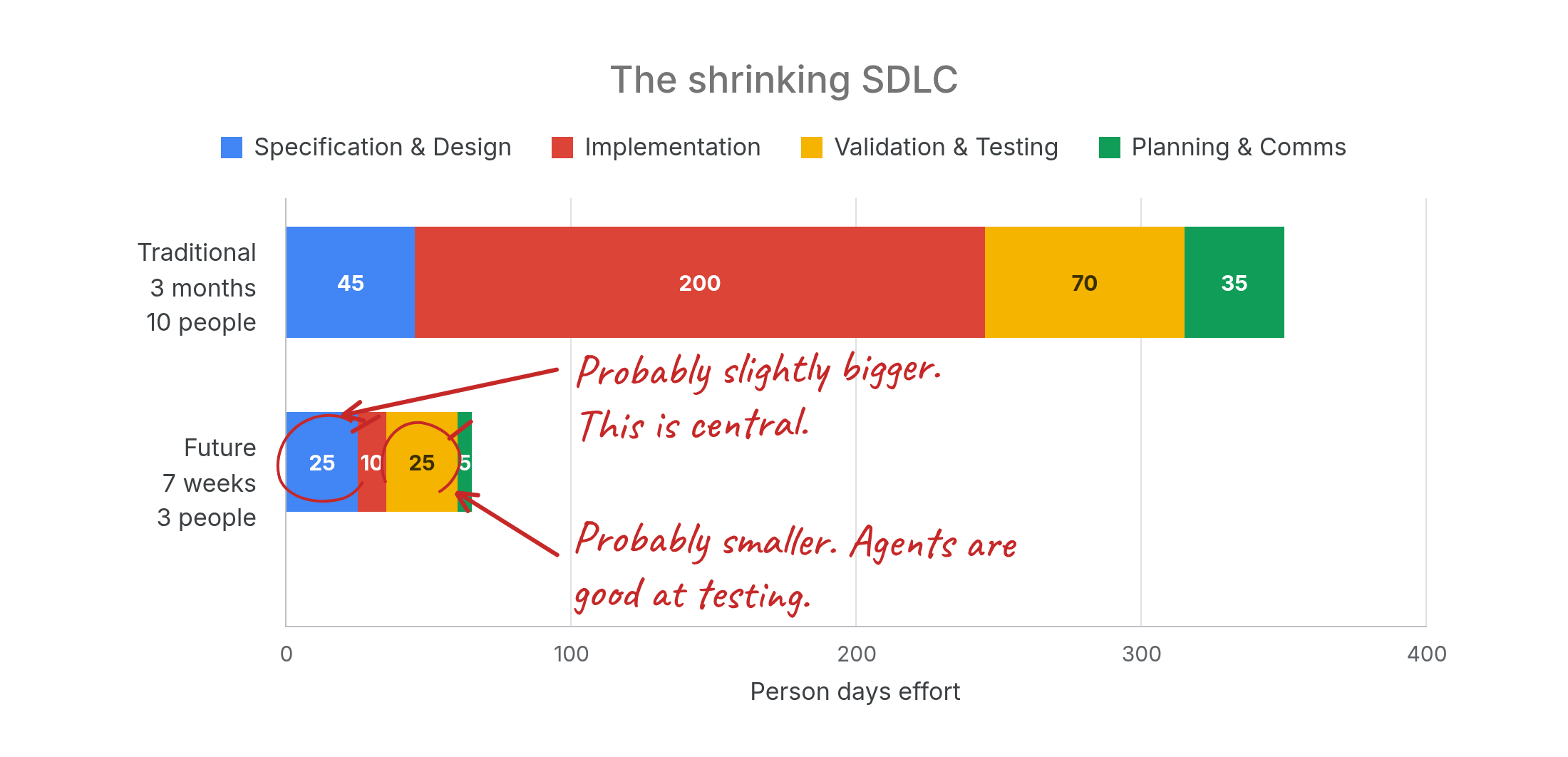
It also points at the rule of thumb I'd most like a reader to take away. Prototyping is the easy bit, and a far smaller share of the job than it looks, even when what you've built appears fully functional. My rough split – i.e. wet finger in the air – is that getting something working is about 20% of the effort and getting it to production with all the boring stuff (analytics, pipelines, monitoring, backup, error handling, infrastructure…) is the other 80%.
So team-size reduction is real, but capped by the specification-and-judgement bottleneck rather than the coding one. Size a team on coding throughput only and you'll be fooling yourself.
The industry predictions, and the ownership bill few have costed
I'd stand entirely behind the six themes I forecast for the software industry: breached moats causing software companies to fail; development cost ceasing to be a competitive edge; per-seat licensing fading; far more software built; a great reskilling; job losses staying modest. I should point out that a one-man project provides little evidence for any of them! They're unmoved because industry headlines and forecasts in the intervening seven months have largely supported these forecasts. It's certainly been the case (in the UK at least) that the demand for software engineer jobs has strengthened and the skills being sought are changing.
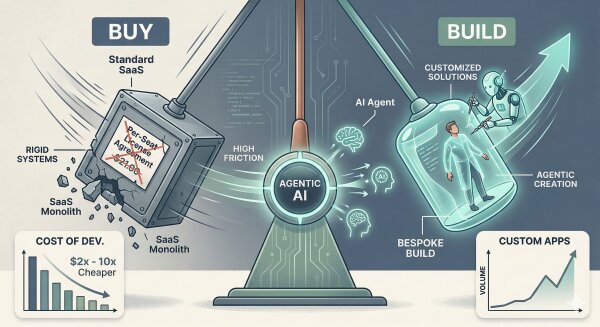
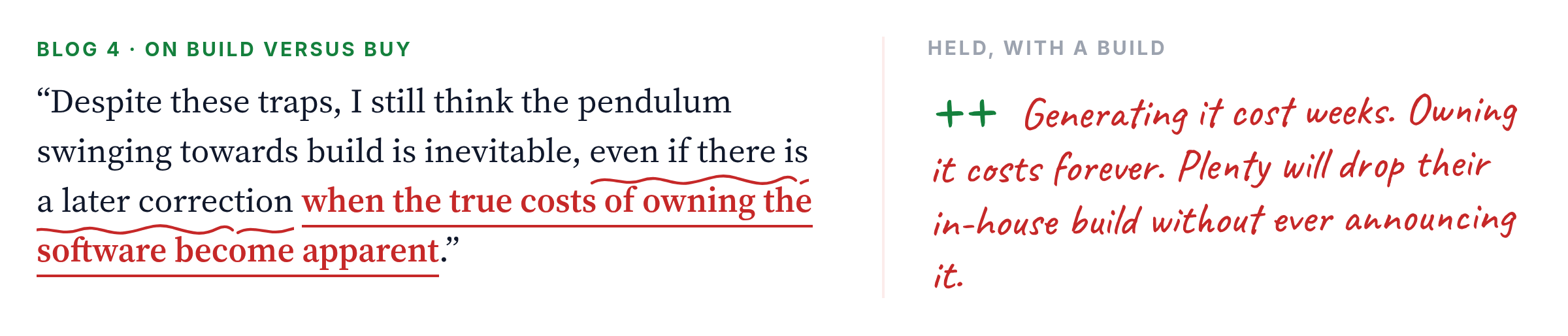
The exception is build versus buy. I wrote that the pendulum swinging towards build is inevitable, even if there's a later correction. It will swing and the evidence is everywhere of folk "trying their hand" at building apps for the first time. But there is huge naivety about what organisations need in order to run and maintain self-built software and agentic systems, as distinct from producing them. Generating code has got dramatically cheaper, but owning it has not.
My scraper agent is the case in point: a few weeks of prompting to produce, and considerably more than that to keep alive, because it contains non-deterministic agents and depends on twenty third-party sites that change without warning. Three costs in particular are being under-recognised.
Agentic code rot as models change. This is a genuinely new cost: every other cost here is already understood from software built the old way. A system with an LLM in the loop sits on ground that moves fast. And swapping a model isn't just tweaking some build config or API calls: you now have to check your eval set is adequate, determine new runtime costs, likely tweak prompts, then repeat (and pay) till you've got output and repeatability you're happy with.
Human oversight. Cheap to build does not mean cheap to watch. Somebody still has to monitor the system and respond appropriately, and on a system that fewer people built with shallower understanding this becomes harder.
Security. Every self-built system is one more attack surface, scoped and defended by a team that built it because building got easy, not because they wanted to own a security perimeter. Moreover, the variety of infrastructure and tech stacks proliferates as more and more people "have a go".
Add the ordinary costs of running any software – infrastructure, monitoring, patching, debugging – and the ownership bill looks rather different from the build estimate. So I'd extend the claim rather than withdraw it: the pendulum swings, and then a good many organisations quietly swing back, dropping an in-house build as the true costs manifest.
What I'd tell a CTO
Here are the key takeaways that I'd emphasise to those shaping software teams and practice in their organisations.
- Spend the majority of your review effort on architecture and design, not detailed implementation. The errors that cost real money are the ones that compound, and those are decided long before they're written.
- Budget for ownership, not just for build. Ask what the system costs in years two and three, when the person who prompted it into existence has moved on.
- And treat prototyping as the easy bit. It's a minority of the work, however finished the demo looks.
None of this is an argument against agentic coding. I thoroughly enjoyed developing this way and I'd do it again tomorrow, including in a higher-stakes setting. While the harnesses and models are getting better rapidly, the pitfalls of agentic coding will mostly reduce, not disappear. Your ratio of "aha, it smashed that" to "good grief, that's dumb" AI-moments is heading firmly in the right direction, so it's only going to get more fun.
This is the second of two pieces on building Race Directory with AI. The first, on why the part the AI built worst was the part that was itself an agent, is here. The report card that goes with it is also a LinkedIn post, where you can join the discussion.